|
|

CHOOSING THE RIGHT LOOP AMPLIFIER AND CABLE
Given a few dimensions and measurements, we can use the table below to get some idea of what equipment might be required. Remember though that any metal arranged in closed paths in the same plane as the proposed loop wire location will degrade performance. This means that additional and more powerful equipment will be required.
The following information is needed to use the table:
- Size of area to be covered - Width x Length where Length is greater than Width.
- Loop wire height relative to floor.
- Aspect Ratio.
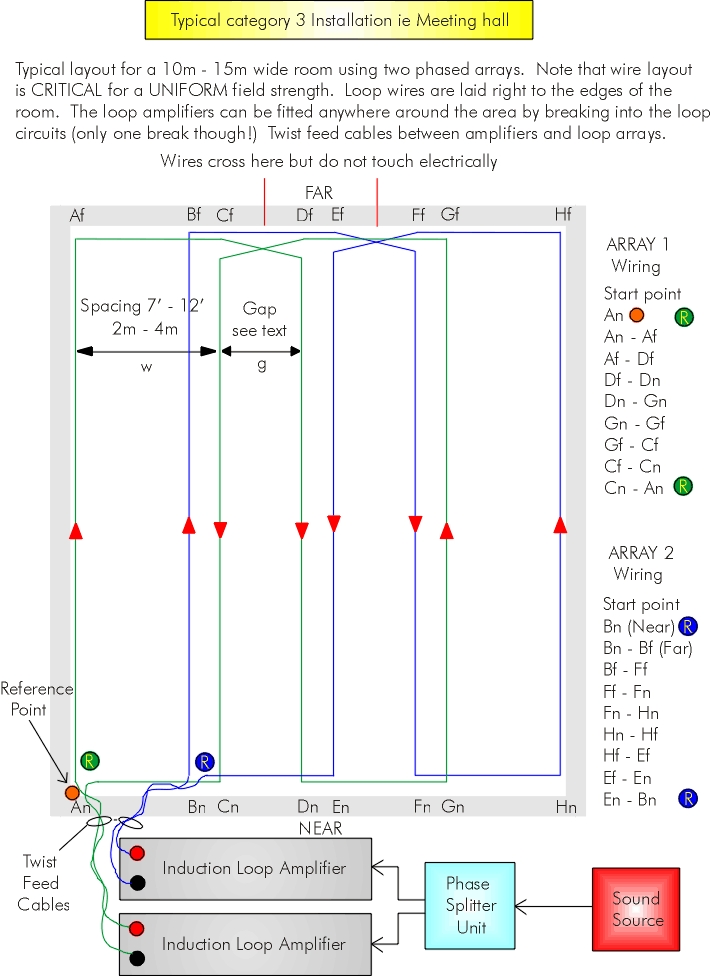
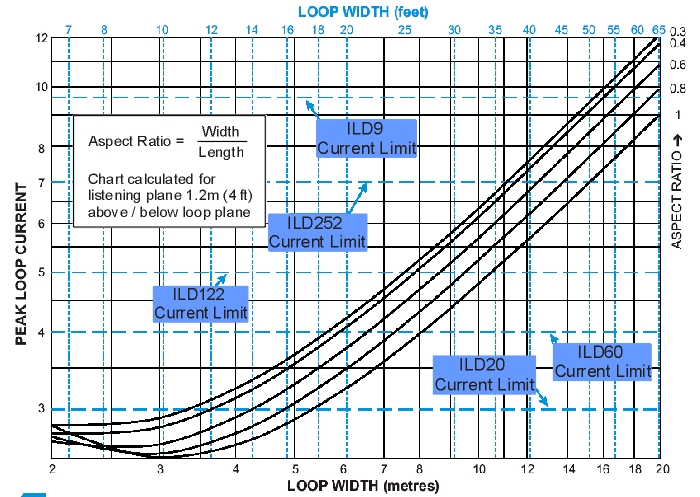
Using the following chart you can determine which amplifier will do the job. For installations with a great deal of metalwork, you will need two identical amplifiers, a pahase shifter and a design.
|
Example
For example suppose you have a small job 10m x 8m with an Aspect Ratio of 0.8 in a building with no metal issues.
- Look on the right hand side of the graph (Aspect Ratio) and find the line 0.8.
- Look on the base line (Loop Width) and find the point that corresponds to your shortest dimension (8m). Follow this line upwards until it crosses the 0.8 aspect ratio curve line.
- Put a dot where the two lines cross.
- You can read the loop Current by projecting your dot to the left hand side (Peak Loop Current).
- Find the nearest dotted blue line ABOVE your dot - This is the amplifier to use.
- If you have a result not on the graph ie 20m width and 0.4 Aspect Ratio, then NONE of the amplifiers will by themselves do the job. You need additional design input from the manufacturer.
For our example we could use an ILD122, ILD252 or ILD9 with the ILD122 being the smallest to do the job. You may wish to use a larger amplifier because of additional input facilities, or built in Metal Loss Corrector circuit. What you CANNOT do is to specify a SMALLER amplifier. Having chosen the amplifier, you need to specify the correct cable to use. The table below gives Minimum and Maximum wire lengths for each cable size when fitted to a particular amplifier.
The table gives you a simple set of guidlines to help select the right size cable for your installation. For an ILD60 for example, the MINIMUM length of 0.5mm² gauge cable is 6(m)eters and the maximum length is 38m. If you use a THICKER gauge of cable - 1.5mm² note that the MINIMUM length is now 17m and the maximum 65m. It's easier to fit a thin cable than a thick one so choose the thinnest size but MAKE SURE it is LONGER than the minimum length. Note that all the designs are for a SINGLE turn of wire.
So for our example of a 10 x 8m room, the total wire length is 10 + 10 + 8 + 8 = 36m (note that for a category 3 design you must add up ALL the wire lengths). From the wire table we could use any cable between 0.75mm² and 2.5mm² or the flat tape if we used an ILD122 amplifier. Normal stranded cable can be used and a tri-rated one best of all as it has a higher temperature rating and will not degrade if close to heating pipes. You MAY use single insulated cables as there are no electrical safety issues. However, be careful not to abrade the cable during installation as a loop cable accidentally connected to earth will cause some VERY odd things to happen and will cause your loop amplifier to run hot or shut down. For this reason, cables with thicker or double insulation are preferred.
That's it, amplifier specified, wire chosen, calculations done and verified. By using this process each time you can ensure that the hard of hearing never miss out because of poor loop design.
|
|
© 1994-2026 DTSystems. All Rights Reserved. |

|
Home | Prices | Contact | Terms | Site Map | Induction Loop Cable Finder |